
Tools and providers
Part of Corporate communications measurement: a UK PR checklist
Corporate communications measurement: a UK PR checklist
A practical corporate communications checklist for UK PR teams: shortlist suppliers, compare like-for-like quotes and test outlet and regulator coverage.
What to take away
- Shortlist named suppliers before comparing features: Cision and Gorkana, Meltwater, Kantar Media, Vuelio, and the UK cuttings bureaux Durrants and Press Data.
- Ask every supplier for a written quote covering the same sources, seats and archive depth, so the fees can be read side by side.
- Regulator sources sit outside a news index. IPSO rulings and Ofcom bulletins need a separate feed you can watch working.
- Run a two-supplier test on one story over the same fourteen-day window, then count matches by outlet type, not by total volume.
- Treat clips that name people as personal data, with a retention period agreed before the feed starts.
Named suppliers for a UK shortlist
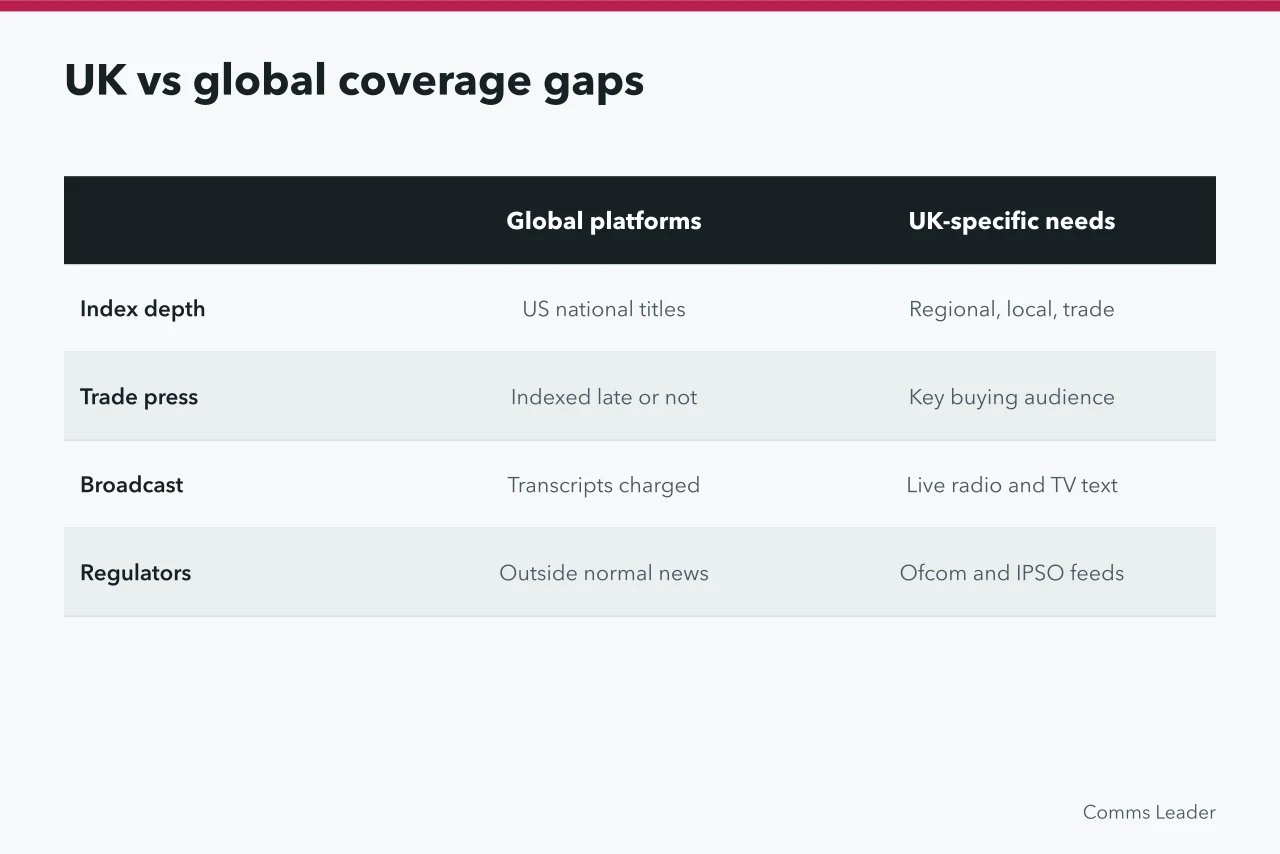
Global platforms index US national titles most deeply. In England the market splits quickly after the nationals into regional dailies, local weeklies, trade press and broadcast. A tool that will not show its UK title list cannot be compared on outlet coverage.
None of the main suppliers publishes a full title list or a public rate card. The table sets out what each is known for and what to demand in writing.
Known for
- Cision and Gorkana
- UK media database, distribution and monitoring
- Meltwater
- Global news and social listening in one dashboard
- Kantar Media
- UK monitoring with broadcast measurement behind it
- Vuelio
- UK media contacts, monitoring and political tracking
- Durrants and Press Data
- UK cuttings bureaux with human tagging
Probe on UK coverage
- Cision and Gorkana
- Regional weeklies and niche trade titles
- Meltwater
- Broadcast transcripts and local titles
- Kantar Media
- Digital-only and trade titles
- Vuelio
- Broadcast depth and social coverage
- Durrants and Press Data
- Digital-only titles and delivery speed
What to ask for
- Cision and Gorkana
- Title list by region and sector, as a spreadsheet
- Meltwater
- Clip counts from the same two-week window
- Kantar Media
- A live search returning radio and TV text
- Vuelio
- The named contacts behind your top ten outlets
- Durrants and Press Data
- Tagging rules and turnaround times in writing
How to compare subscription quotes
Monitoring, distribution and social listening are usually sold as separate modules on one annual contract, which makes a headline fee misleading. Price one real reporting job across both shortlisted tools instead.
Ask each supplier to quote for the same twelve months, the same outlet list and the same number of users. Anything outside that scope becomes a second column you have to explain.
Fees move with sources, seats and archive depth, so a like-for-like quote beats a headline figure. If you need to show which clip produced which outcome, read the attribution methods for corporate communications before you fix a fee.
How to run a two-supplier coverage test
Run the test as a job, not as a free trial. Give it a start date, an end date and a named reviewer.
A two-supplier coverage test
- Pick one story that ran in a national, a regional daily and a trade title. Save those links yourself first.
- Give both suppliers the same fourteen-day window and the same keyword list. Do not coach either side.
- Count matches by outlet typenational, regional, trade, broadcast, regulator.
- Ask for the raw export, not a dashboard screenshot. If it will not rebuild in a spreadsheet, your reporting is locked to that vendor.
- Log every miss in one shared file and give each supplier a right of reply.
- Agree in advance which person arbitrates if the two exports disagree.
Fourteen-day tool test
- Pick two named tools
- Give same 14-day window and keywords
- Count matches by outlet type
- Ask for raw exports, not dashboards
- Log every miss
Publish the gaps in every report, including the sources the tool cannot see.
Regulator sources: Ofcom bulletins and IPSO rulings
IPSO publishes its rulings on its own site. Ofcom publishes the broadcast bulletin on its own site. Neither sits in a standard news index, so a supplier needs a separate feed to capture them.
Treat regulator coverage as unproven until a named person runs a live search that returns one Ofcom bulletin entry and one IPSO ruling.
If the clips feed a policy team, press the devolved coverage questions in our review of UK public affairs software for comms teams.
The requests behind many of those documents run on the Freedom of Information Act 2000, which covers England, Wales and Northern Ireland.
Data rights, defamation and clip retention
Clip libraries hold names, quotes and photographs, so most of the data is personal data. The conditions for processing it sit in the Data Protection Act 2018. Agree a retention period before the feed goes live.
Reusing a claim in an internal newsletter or a public dashboard can create fresh exposure. Defamation rules for England and Wales sit in the Defamation Act 2013, and Scotland follows its own route.
Keep a source register for each tool: the outlets covered, the date the list was last checked, and the owner.
Common questions
Which tools index Ofcom bulletins and IPSO rulings?
The shortlist does not identify any supplier with confirmed coverage of both. Check Cision and Gorkana, Meltwater, Kantar Media, Vuelio, Durrants and Press Data individually; ask each for a live demonstration returning one Ofcom bulletin entry and one IPSO ruling in the same search.
Can one platform cover press, broadcast and social?
Often, with gaps. Broadcast transcripts and regional titles are the usual misses, so test both before signing a long contract.
How should we compare quotes from different suppliers?
On one scope: same months, same outlet list, same seats, same archive depth. Then price one real reporting job across both tools.
Do we still need a spreadsheet layer?
In most teams, yes. No single tool holds every source, and a spreadsheet keeps the gaps visible when a total is questioned. The habits in our piece on measurement reporting mistakes show how a thin source list can pass unnoticed.